


Warts are small growths on the skin of the body or face.Their formation is related to the activity of human papillomavirus (HPV).There are approximately a hundred species of this virus, each causing the formation of a different type of wart.
What are warts?
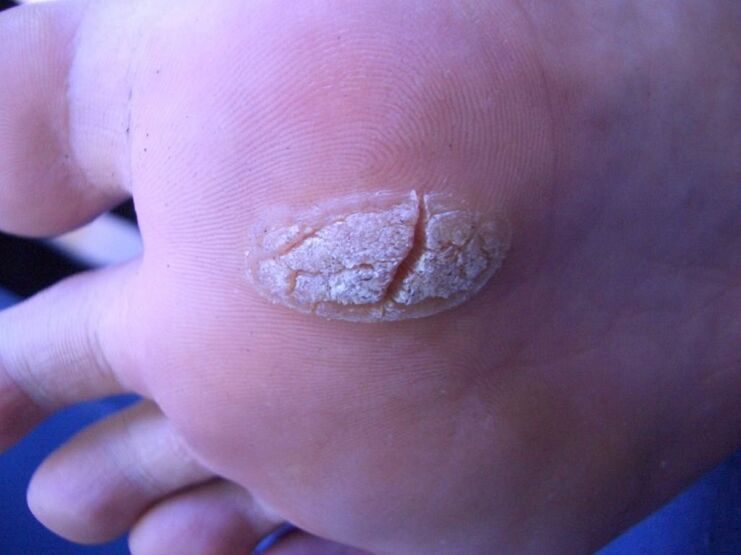
Even on the neatest, healthiest skin, warts—small, round nodules that are benign tumors—can appear.
Warts are benign growths on the skin of the body that are associated with the activity of the HPV virus.About 70% of the world's population is infected with the virus.Due to its action, the pathological process of epidermal cell division begins, leading to the appearance of small skin growths or warts.
There are different types of warts, caused by different strains of viruses.Not all warts are viral in nature; aging growths that occur due to changes in metabolic processes in the body are individually recognized.
To eliminate this growth, you need to understand why it occurs.The following reminders about types of body warts, their characteristics, and ways to combat them will be helpful.
Common warts
Simple or vulgar warts are small round growths that do not differ in color from skin tone.They are produced due to the action of the human papillomavirus.Favorite areas to target are areas that sweat more.Common warts most commonly appear on the hands, feet, back, and sides.
It takes approximately several months from the time of infection with the virus for this growth to occur.If a person's immunity is strong, the body itself will defeat the virus and warts will not appear on the skin.The activation of pathological processes and the formation of unsightly growths occur against the background of decreased systemic and local immunity.Due to the particularity of the site where common warts occur, this process is often caused by a decrease in local immunity, such as when the skin is damaged, or when the feet or palms sweat excessively.
Common warts are considered harmless growths.They almost never degenerate into malignant tumors.
Common warts can appear on anyone.Children, teenagers, and adults experience these problems equally often.You can delete them in several ways:
- freezing damage;
- laser;
- surgical methods;
- Preparations containing bases;
- Folk remedies.
It is recommended that large common warts be removed at a dermatologist's office, as self-treatment may cause scarring.
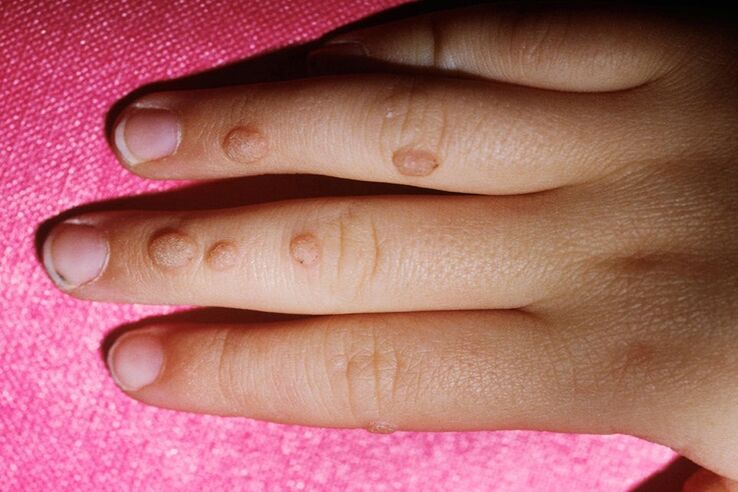
Common warts are the most common type.
Flat warts
You can easily identify the type of wart from a photo.One of the rarer types is flat warts.They account for only 4% of cases of skin growths.
Characteristics of flat warts:
- The diameter does not exceed 5 mm;
- slightly above skin;
- irregular shape;
- clear boundaries;
- Smooth surface;
- Mild pigmentation.
These warts are a slightly different color than healthy skin - they are slightly more pink or brown, which makes them easy to see.The second name for flat warts is juvenile flat warts.They are more common in children and teenagers.Classic areas are the skin of legs, hands, and face.
Juvenile warts are viral in nature and are caused by HPV.They are less likely to degenerate into malignant tumors and are therefore relatively safe.
This growth poses no health hazard and does not cause discomfort other than aesthetics.If there are many of them or they are located in open areas of the body, removing the growths is not difficult.To avoid scarring, cryoablation, electrocoagulation or laser removal is recommended.
genital warts
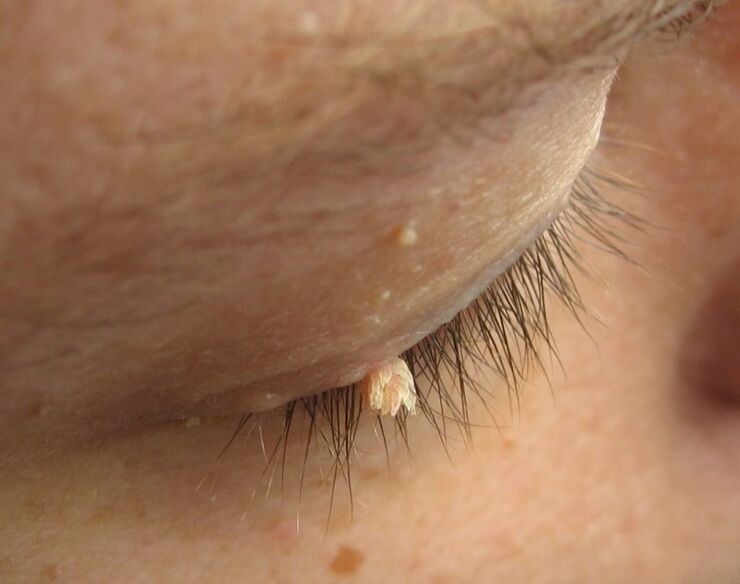
Genital warts and papillomas are a much more serious threat to women's health than men's.
Genital warts are small growths with papillary structures that affect the external genitalia of both women and men.These growths are viral in nature; the strain of HPV that causes these warts is sexually transmitted.
Characteristics of genital warts:
- Small size, thin legs;
- The color is indistinguishable from that of the skin or mucous membranes;
- Can merge into large tumors;
- It's easy to get injured.
Genital warts are a type of wart that is easy to identify from photos.Most commonly, they are located on the external genitalia in women, around the glans penis and on the shaft of the penis in men.Genital warts can affect the perineum, the area around the anus, and rarely, the mouth.
Certain strains of HPV can cause genital warts on a woman's cervix.This type of growth is very dangerous and can lead to cervical cancer.Generally, common genital warts located on the labia minora or penis are not considered carcinogenic.
Liquid nitrogen is most commonly used to remove them.This treatment allows you to eliminate the growth without leaving scars.Genital warts on the labia can be removed using radiotherapy.
Tumors on the mucous membrane cannot be removed at home, since the epithelium of the reproductive organs may be damaged.
papilloma
Papillomas are a type of skin wart.There are several types on the skin.In fact, common warts are a type of papilloma.These growths can appear anywhere in the body, including mucous membranes.They are a soft ball of uniform structure that rises above the skin thanks to a small stem.Papillomas are caused by the HPV virus; depending on the strain, they affect the epidermis and mucous membranes.The most dangerous places to grow locally:
- urethra;
- throat;
- anus;
- armpit;
- inguinal folds;
- soles of feet.
Urethral papillomas can cause discomfort because the body sees them as potentially dangerous objects.They can grow and cause narrowing of the male urethra, so they must be removed.
Growths in the larynx can cause ongoing throat irritation and voice changes.Anal papillomas are easily injured and may become inflamed.Growths located in skin folds can cause severe friction when walking.This can lead to irritation and infection.
Papillomas are potentially dangerous skin tumors.Only a doctor can accurately determine cancer risk.
Injury and damage to such growths can lead to the development of malignant processes, so papillomas located in inconvenient places, where they may be accidentally touched by nails or rubbed by clothing, must be removed.
Papillomas can appear in people of any age and gender.To remove them, treatments for common warts can be used.
Keratoma
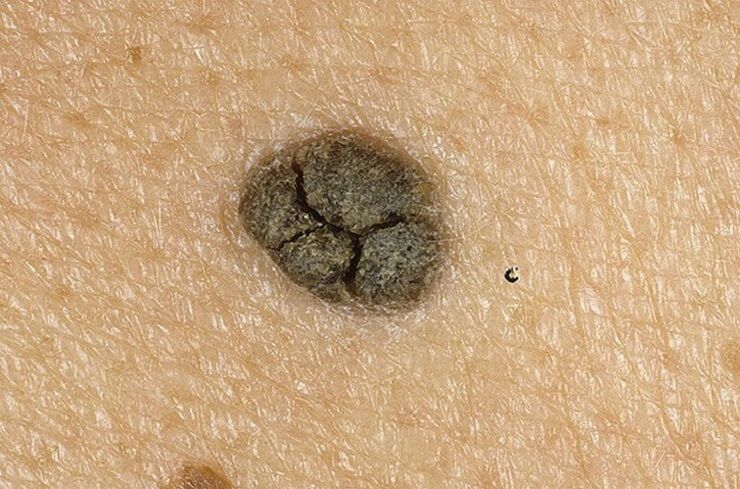
Common locations for senile keratomas are the backs of the hands, face, and neck; less commonly, they can be located on the trunk.
Keratoma is a growth of the stratum corneum of the skin.It is a brown spot that stands out on the skin.The spots have a rather dense structure, which is due to keratinization (keratinization) of the upper layers of the epidermis.
The main causes of keratomas are the effects of ultraviolet radiation on the skin and age-related epidermal changes.These tumors are not the result of HPV and are age-related skin diseases.Keratomas occur only in people over 50 years of age.
They are considered safe tumors with very low carcinogenicity.This growth can be located in any open area of the body.
The tumor itself is a significant cosmetic defect, so it can be removed.Keratoma should be removed using professional methods - cryodestruction, laser removal, electrocoagulation.Particularly large tumors are removed by surgical excision.
filiform papilloma
There are several types of wart-like growths on the body; filamentous papilloma is one of the most common types of warts.They appear in people over 40 years old.Most often, women experience this tumor because their skin is thinner than men's.Location of filiform papilloma:
- neck;
- armpit;
- Face;
- eyelids;
- Infrabreast area;
- Inguinal folds.
This type of growth is a small, oval-shaped nipple that protrudes above the skin.The size of the nipple is very small - no more than 1 mm in diameter and a few millimeters in length.
Linear growths do not pose a health hazard because they almost never degenerate into malignant tumors.The only exceptions are cases of severe impairment of growth and secondary infection.
It is impossible to remove filiform papilloma using folk or medicinal treatments.Because of their small size, strong exposure to alkalis and acids can cause deep wounds to form, leaving large scars.To remove these small growths, it is best to use laser, electrocoagulation or liquid nitrogen as a priority.
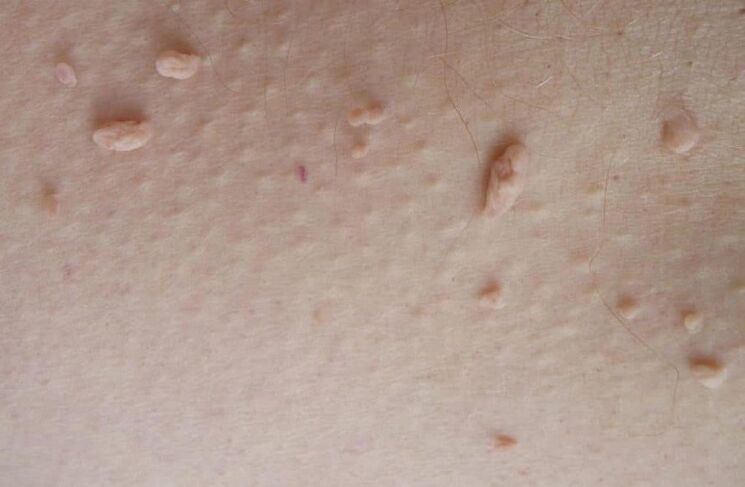
Threaded papilloma usually affects the neck and armpits.
plantar warts
Another manifestation of the HPV virus is plantar warts or prickles.These growths are flat patches that appear on the feet and look similar to calluses.The characteristic feature of this type of wart is that it penetrates deep beneath the skin, while the upper part of the growth is flat and barely prominent against the background of healthy epidermis.
Plantar warts dig deep into the skin and can be painful when pressed.Both children and adults may encounter them.The spine should be removed using laser, cryodestruction, or surgical methods.Home remedies are effective only in removing small pricks no larger than 2-3 mm in diameter.
Spinal cords can cause severe discomfort but are safe because they cannot degenerate into cancer.
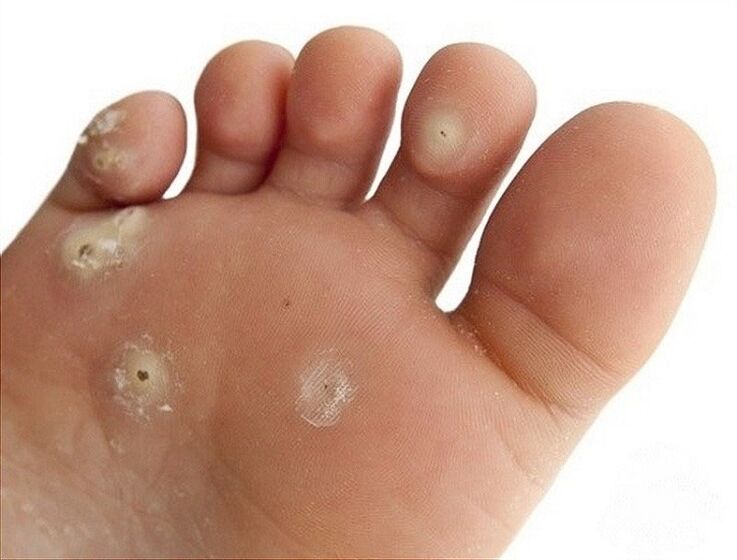
Plantar warts are not dangerous, but they can cause discomfort when walking.
Diagnosis – Which doctor should I contact?
To diagnose and remove warts on the skin of the body and face, you should consult a dermatologist.In order to make a diagnosis, a visual examination is required.Examination with a dermoscope will help determine the exact type of growth.
If you develop growths on your genitals, you should contact your gynecologist (for women), urologist (for men), or a sexually transmitted disease specialist.PCR analysis of urogenital smears is required to identify the viral strain.Based on the test results, the doctor determines an acceptable method of tumor removal.